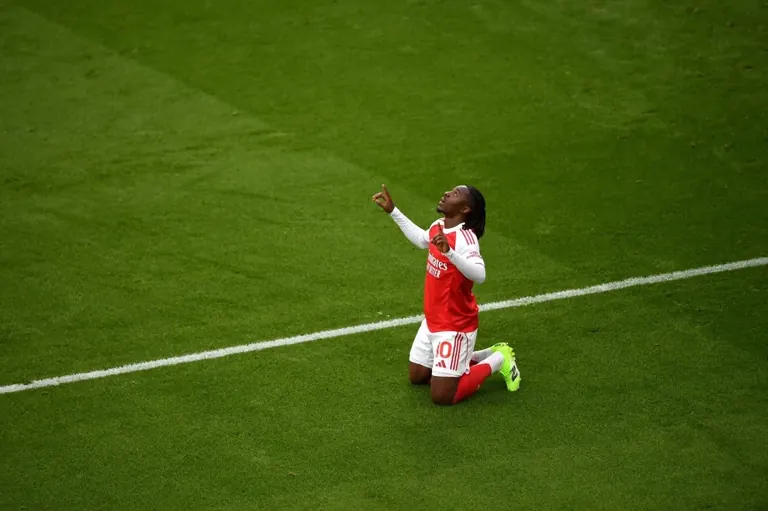
Arsenal Women's games are unravelling late — the pattern behind it

Credit: Getty Images
Arsenal Women have now lost back-to-back away games, and a clear trend is emerging in how those defeats are arriving: late, and almost always after the substitutions.
Sunday's 4-2 loss at Manchester City followed the same shape as recent outings. Arsenal were level at 2-2 when the first round of changes were made, and City pulled away after introducing Beney, Casparij and Fowler from their own bench.
The Friday Injury Tracker
Who's out, who's back and what it means for the next two games.
Renee Slegers was asked by the Guardian's Tom Garry whether the substitutions had decided the game. "They get immediate effect when they make their changes," she said. "They changed their full-backs. Casparij gets the ball on the edge of the box, shoots and scores the goal. The clearest example of the effect that they get. We have a quality squad."
Slegers: 'It's been a super strength'
The Arsenal head coach acknowledged the bench has not delivered what it did last term. "We have starters. We've gotten more consistent with the starting team. We have players that can come on and change the game for us. It's been a super strength and it needs to be our super strength," Slegers said.
"But that's also one of our reflections, that we haven't had the same effect as last season and this season before. It's always been our strength. We've been scoring goals in the last 15 minutes of games and the last couple of games it hasn't been the case."
After the 1-0 defeat at Chelsea the previous weekend, Slegers rejected the suggestion that changes were confusing her side. "I think we have a lot of clarity in the way we want to play and principles, so all players can execute that," she said. "They know it. But of course, there's different qualities in different players, so you have to make small adjustments in what you want to achieve."
The numbers behind the drop-off
As Tim Stillman writes for Arseblog News, the trend extends beyond Manchester. Arsenal led 2-0 in Paris before making second-half changes and conceded twice in the final 18 minutes — and their xG rose only from roughly 1.3 to 1.7 across those closing 40 minutes. Against Koge, Arsenal's xG flatlined entirely between the 65th and 85th minutes, according to data from Scott Willis of Cannon Stats.
The one change that has demonstrably swung a match was Smilla Holmberg's introduction against Manchester United, where she scored a stoppage-time equaliser and delivered nine crosses into the box in 32 minutes.
Stillman's analysis points to a squad-profile issue: with Mariona deployed as a winger, Arsenal are effectively fielding four midfielders and lack runners to stretch low blocks. Geraldine Reuteler, a player Arsenal pursued for a full year, has barely featured, while Selina Cerci's four substitute appearances total just 59 minutes.
Slegers explained earlier in the campaign that the club had consciously expanded the squad, particularly in attack. "It also makes my job harder and it's small margins and that's something we need to manage really, really well with the squad because it's new to us, it's new to the players as well," she said.
With the depth now in place, the challenge for Slegers is turning those options back into the late-game weapon they were last season.
The Friday Injury Tracker
Who's out, who's back and what it means for the next two games. Free, in your inbox every Friday.