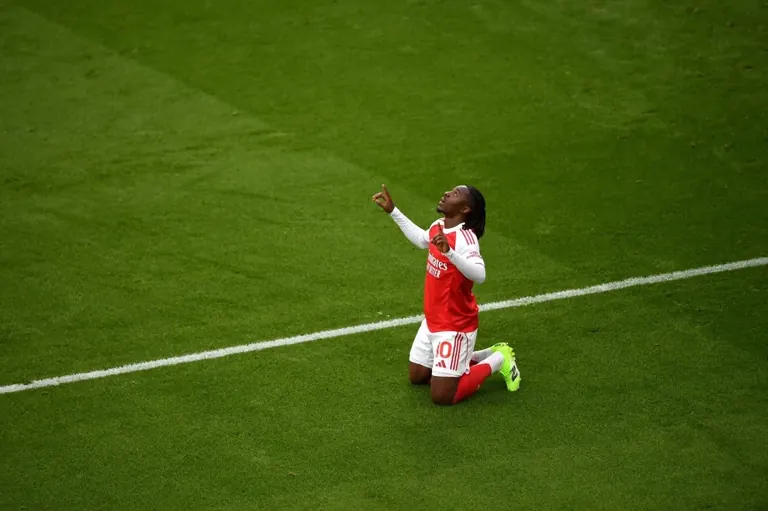
How Lewis-Skelly's new role explains Arsenal's evolving system

Credit: Getty Images
Arsenal's 3-0 defeat by Brighton before the international break was not simply a bad day at the office. It was, according to detailed tactical analysis from the BBC's football tactics correspondent Umir Irfan, a rare moment where Arsenal were comprehensively outclassed by an opponent willing to take risks of its own.
Mikel Arteta admitted as much afterwards. 'Brighton were really good,' he said, before adding: 'You could see from the first throw-in, it was so clear. We put ourselves in trouble one, two, three times. We need to get out much quicker than that, and that's one of the biggest lessons we have to take from the game today.'
The Friday Injury Tracker
Who's out, who's back and what it means for the next two games.
A new shape built around Lewis-Skelly
This season Arsenal have shifted to a 3-1-6 shape in possession. Declan Rice now drops deeper to form a back three alongside Gabriel Magalhaes and Ezri Konsa, rather than pushing forward as he often did last term. That change frees Myles Lewis-Skelly to operate as the single pivot, the link between defence and attack.
The 20-year-old has made the role his own through his composure on the ball, his strength in holding off opponents, his ability to beat a man one-on-one, and his willingness to play risky forward passes. His influence has not gone unnoticed outside the club either — England manager Thomas Tuchel used an almost identical structure during the international break, deploying Elliot Anderson in the 'Rice role' within a back three while Lewis-Skelly occupied the same pivot position for his country.
Around that base, Riccardo Calafiori, Ben White and Martin Odegaard rotate into deeper pockets at different moments, turning the base into a back four or a double pivot depending on the situation. These sudden movements are designed to confuse opponents and create passing options that are difficult to track.
Why Brighton caused problems
Part of the issue against Brighton, per the analysis, was that Bruno Guimaraes occupied the pivot role rather than Lewis-Skelly. Fabian Hurzeler's side pressed man-to-man with intensity both in open play and from deeper positions, repeatedly swarming the ball and denying Arsenal time to build in their usual rhythm. That unfamiliar, chaotic picture is precisely what allowed Brighton to dominate.
It echoes, in some ways, Pep Guardiola's zonal 4-2-4 plan that beat Arsenal in last season's Carabao Cup final — a tactic Enzo Maresca later tried again in this season's Community Shield, only for Arsenal to find solutions the second time around having had time to prepare.
A deliberate gamble
Arsenal have also leaned into more asymmetrical, fluid attacking patterns this season, often overloading the right side through Kai Havertz, White, Bukayo Saka, Rice and Odegaard interchanging positions to create space elsewhere on the pitch.
It is a style built on higher risk and higher reward, a shift that reflects a manager willing to move away from the control-first approach that delivered the Premier League title. Arteta now has the chance to show how he responds to adversity when Arsenal host Leeds on Saturday, in what will be viewed as another step in this ongoing tactical evolution.
The Friday Injury Tracker
Who's out, who's back and what it means for the next two games. Free, in your inbox every Friday.